
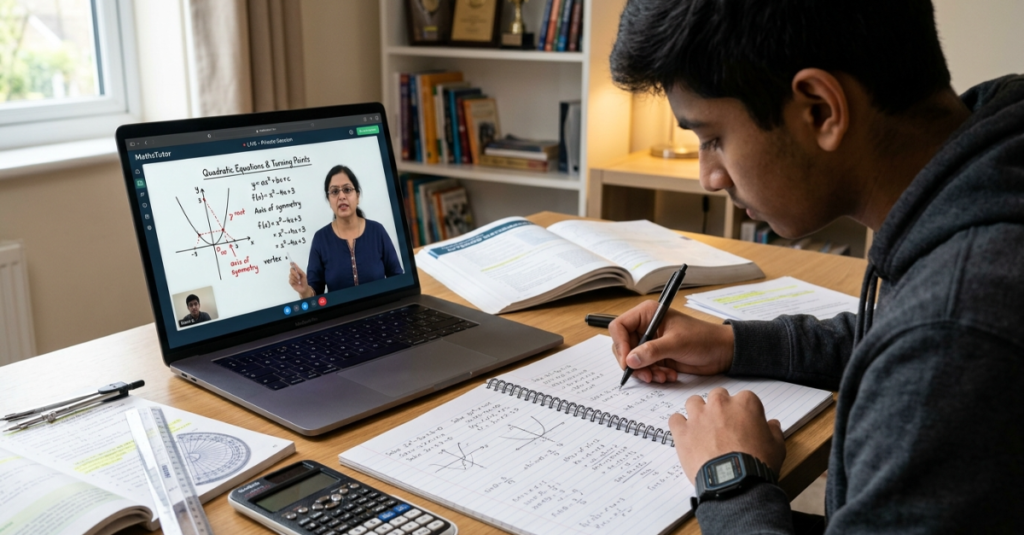
What High Scorers in IGCSE Extended Maths Do Differently
A lot of students think people who score really high in IGCSE extended maths are just naturally good at maths. Honestly, that’s not true most of the time. If you actually talk to top scorers, you’ll notice they usually just study in a smarter way.
They don’t spend all day solving impossible questions or memorizing entire textbooks. Instead, they focus on understanding concepts properly, practicing consistently, and learning from mistakes instead of getting scared of them.
Most students who struggle with maths are not “bad at maths.” They just use study methods that don’t really work for this type of exam.
How High Scorers Approach IGCSE Extended Maths Beyond Memorization
One major difference between average students and high scorers in IGCSE extended maths is how they study formulas.
Average students usually try to memorize everything. Top students try to understand why formulas work in the first place. That makes a huge difference during exams because questions are often twisted in different ways.
When students actually understand concepts, they can handle unfamiliar questions without panicking.
Difference Between Average Students and High Scorers
| Average Students | High Scorers |
| Memorize formulas | Understand concepts |
| Avoid difficult questions | Practice hard questions |
| Study only before exams | Study consistently |
| Get frustrated by mistakes | Learn from mistakes |
| Focus only on answers | Focus on method and logic |
High scorers also spend more time practicing basics properly. Topics like:
- Algebra
- Graphs
- Trigonometry
- Functions
- Mensuration
become much easier later when foundations are strong.
Another thing top students do differently is reviewing mistakes. Instead of just checking the correct answer and moving on, they actually ask themselves:
- Why did I get this wrong?
- Did I rush?
- Did I misunderstand the question?
- Was it a calculation mistake?
That habit helps them improve much faster over time.
Why Many Top Students Use an IGCSE Crash Course Online Before Exams
As exams get closer, students usually start realizing they don’t have enough time to revise everything calmly. That’s why many students join an igcse crash course online before finals.
Crash courses help students revise faster and more strategically. Instead of wasting hours figuring out what to study next, students get a proper structure and focused revision plan.
Benefits of an igcse crash course online
| Benefit | Why It Helps |
| Structured revision | Saves time |
| Quick doubt-solving | Clears confusion faster |
| Exam-focused practice | Improves confidence |
| Topic prioritization | Helps focus on important areas |
| Time management practice | Improves exam speed |
A lot of students think crash courses are only for weak students, but even strong students use them. High scorers usually join these courses to sharpen exam techniques and improve speed before finals.
One big advantage is that crash courses help students avoid panic studying. Random revision usually creates more stress because students feel lost and overwhelmed.
But when revision becomes organized, studying feels much more manageable.
Of course, students still need to participate actively. Just watching videos without solving questions yourself doesn’t really help much in maths.
The Study Habits That Make an IGCSE Revision Crash Course Actually Effective
Not every student gets the same results from an igcse revision crash course. Some students improve a lot while others barely improve at all.
The difference usually comes down to study habits. High scorers don’t just sit and watch lessons passively. They stay involved during revision by solving questions, practicing under time pressure, and reviewing mistakes carefully.
Habits That Actually Improve Maths Scores
| Good Revision Habits | Poor Revision Habits |
| Solving questions daily | Only reading notes |
| Practicing with timers | Ignoring time pressure |
| Revising weak topics first | Revising only easy topics |
| Reviewing mistakes | Repeating same errors |
| Following a study plan | Random studying |
Timed practice is super important in maths because many students lose marks simply because they panic or run out of time during exams.
Top students prepare for that pressure before the actual exam happens.
They solve:
- Past papers
- Timed worksheets
- Mixed-topic questions
- Difficult application problems
This helps them become more comfortable with exam conditions.
Another smart thing high scorers do is analyze past papers carefully. They notice patterns in questions and understand which topics appear more often. That makes revision much smarter instead of harder.
How Students Choose the Best Platforms for IGCSE Tutoring Without Wasting Time
These days, students have access to so many online learning options that choosing the right one can get confusing. That’s why students now search carefully for best platforms for IGCSE tutoring instead of joining random classes. Most students want learning support that actually saves time and improves understanding.
What Students Look for in best platforms for IGCSE tutoring
| Important Feature | Why Students Want It |
| Personalized teaching | Focuses on weak areas |
| Flexible timings | Easier to manage schedules |
| Experienced tutors | Better explanations |
| Interactive sessions | Keeps students engaged |
| Exam-focused support | Helps improve scores |
Personalized tutoring helps a lot because every student struggles with different topics. Some students are weak in algebra while others struggle more with geometry or graphs.
Good tutoring focuses directly on those weak areas instead of teaching everything at the same speed.
Students also prefer flexible learning now because school schedules are already stressful enough. Online tutoring makes it easier to study from anywhere without wasting extra travel time. Another underrated advantage is confidence.
Many students feel embarrassed asking questions in crowded classrooms. But during one-on-one sessions, students usually feel much more comfortable discussing doubts openly.
That confidence often improves performance faster than students expect.
Final Thoughts
Students who score well in IGCSE extended maths are usually not “math geniuses.” Most of them simply build better study habits and stay consistent throughout the year.
They focus on:
- Understanding concepts
- Practicing regularly
- Learning from mistakes
- Solving timed questions
- Revising strategically
An igcse crash course online can help students revise more efficiently before exams, especially when combined with active practice and proper time management.
Similarly, an igcse revision crash course works best when students participate actively instead of studying passively.
And students searching for best platforms for IGCSE tutoring should focus on personalized support and structured learning instead of choosing random options.
Maths confidence builds slowly through practice. The more questions students solve, the more comfortable maths starts feeling over time.
If you are looking for flexible support and structured learning for IGCSE preparation, explore Eclassopedia and make maths preparation less stressful and more effective.
Stuff Students Usually Panic About Before Exams
1. Is IGCSE Extended Maths only for naturally smart students?
Not at all. Most students improve through practice and consistency, not natural talent.
2. How do top scorers study maths differently?
They focus more on understanding concepts and practicing questions instead of memorizing formulas blindly.
3. Are crash courses actually useful?
Yes, especially before exams when students need fast revision and better exam strategies.
4. Why do students lose marks even when they know the topic?
Usually because of silly mistakes, time pressure, or panic during exams.
5. How important are past papers?
Very important. Past papers help students understand question patterns and improve speed.
6. Can students improve in maths within a few months?
Definitely. With proper practice, structured revision, and consistent effort, students can improve a lot in a short time.


