

How to Choose IB Subjects for College Success: The Ultimate Guide to Strategic Course Selection
Choosing your International Baccalaureate (IB) subjects is one of the most critical decisions you’ll make in high school. These choices don’t just shape your next two years—they directly influence your college admissions prospects, scholarship opportunities, and future career paths. With over 5,700 universities in 159 countries recognizing IB credentials, making strategic subject selections can be the difference between receiving a conditional offer from your dream university and falling short of requirements.
This comprehensive guide walks you through everything you need to know about selecting IB subjects that align with your college goals, from understanding the diploma structure to matching courses with specific majors and creating a balanced academic portfolio.
Understanding the IB Diploma Programme Structure
Before diving into subject selection strategies, it’s essential to understand how the IB Diploma Programme works. The curriculum consists of six subject groups plus three core components that together create a holistic educational experience.
The Six Subject Groups
Students must select one subject from each of the following groups:
Group 1 – Studies in Language and Literature: This is typically your native language, with options including Language A: Literature, Language A: Language and Literature, or Literature and Performance. Strong performance in this group demonstrates critical reading, analytical writing, and communication skills valued by universities worldwide.
Group 2 – Language Acquisition: Choose a second language based on your proficiency level. Language B courses suit students with prior learning, while ab initio courses are designed for complete beginners. Bilingual diplomas are particularly attractive to international universities and can fulfill language requirements for visa applications.
Group 3 – Individuals and Societies: This humanities group includes Economics, History, Geography, Psychology, Global Politics, Business Management, and more. These subjects develop critical thinking, research capabilities, and understanding of human behavior—skills essential for law, politics, business, and social sciences.
Group 4 – Sciences: Options include Biology, Chemistry, Physics, Environmental Systems and Societies (ESS), Computer Science, Design Technology, and Sports Science. STEM universities pay close attention to your science selections, often requiring specific subjects at Higher Level.
Group 5 – Mathematics: Two distinct pathways exist—Mathematics: Analysis and Approaches (AA) for pure math and theory-heavy disciplines, or Mathematics: Applications and Interpretation (AI) for practical, real-world applications. Both are available at Higher Level and Standard Level.
Group 6 – The Arts: Visual Arts, Music, Theatre, Film, and Dance comprise this optional group. Students can substitute Group 6 with an additional subject from Groups 1-4, which many do to strengthen their academic profile or take multiple sciences.
Higher Level vs. Standard Level
Students must take three or four subjects at Higher Level (HL) with 240 teaching hours, and the remaining at Standard Level (SL) with 150 teaching hours. Universities scrutinize HL subjects intensely, as they demonstrate deeper commitment and mastery. For competitive programs, achieving grades of 6-7 in relevant HL subjects can be more important than your overall diploma score.
The Core Components
The Extended Essay (4,000-word research paper), Theory of Knowledge (epistemology course), and Creativity, Activity, Service (CAS) requirements round out the diploma. Together, these can contribute up to 3 bonus points to your total score and demonstrate research capability, critical thinking, and community engagement—qualities top universities actively seek.
Key Factors to Consider When Choosing IB Subjects
1. Research University Requirements Early
The most crucial step in subject selection is understanding specific university and program requirements. Many competitive degrees have non-negotiable prerequisites:
- Engineering Programs: Almost universally require Mathematics: Analysis and Approaches HL and Physics HL, with Chemistry HL strongly recommended
- Medicine and Life Sciences: Expect Chemistry HL and Biology HL as mandatory, often with HL Mathematics
- Economics and Business: Top programs require Mathematics HL (either AA or AI), with Economics HL preferred
- Computer Science: Mathematics AA HL and Computer Science HL open the most doors
- Law and Humanities: History HL, English Literature HL, or Global Politics HL demonstrate strong analytical capabilities
Universities use specific terminology in their requirements:
- Required subjects: Must be completed for admission consideration
- Preferred subjects: Not mandatory but give your application competitive advantage
- Recommended subjects: Suggested but not essential
Check requirements for UK universities (which often specify exact HL subject combinations), US colleges (which use more holistic review), and Canadian universities (which offer generous transfer credits for high IB scores).
2. Align Subjects with Your Strengths and Interests
While meeting requirements is essential, choosing subjects where you can excel is equally important. A score of 40 with strong HL grades in relevant subjects often looks better than a 42 with weak performance in your intended major’s prerequisites.
Ask yourself:
- Which subjects do I consistently perform well in?
- Where do my natural talents lie—analytical thinking, creative expression, or quantitative reasoning?
- Am I genuinely interested enough in this subject to write a 4,000-word Extended Essay on it?
Taking subjects purely because they “look impressive” without passion or aptitude leads to burnout and disappointing grades. Universities value authentic engagement over forced perfection.
3. Balance Your Workload Strategically
The HL/SL distribution significantly impacts your two-year experience. Most students thrive with three HL subjects, while taking four HLs should only be considered if:
- You’re exceptionally strong academically
- Universities specifically require four HLs for your target program
- You have clear strategies for managing the increased workload
Consider mixing content-heavy subjects (History, Biology) with more skills-based courses (Mathematics, Economics) to create balance. Avoid taking multiple essay-intensive humanities at HL simultaneously unless you’re pursuing a humanities major.
4. Keep Future Pathways Open
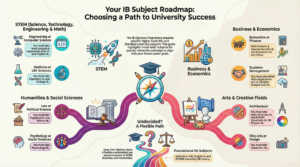
If you’re undecided about your major, choose subjects that don’t close doors prematurely. A combination like English HL, Mathematics AI HL, Chemistry HL, Economics SL, Spanish B SL, and Biology SL keeps options open for both STEM and humanities pathways.
Students who combine sciences with humanities demonstrate intellectual breadth that liberal arts colleges particularly value. However, ensure you’re not stretching yourself too thin trying to cover all bases.
College Major Recommendations: Matching IB Subjects to Career Paths
STEM Fields
Engineering (Mechanical, Electrical, Civil, Aerospace)
- Essential HLs: Mathematics: Analysis and Approaches HL, Physics HL
- Strongly Recommended: Chemistry HL (especially for Chemical Engineering)
- Additional Subjects: English A HL, Computer Science SL, Economics SL
Universities like MIT, Caltech, Imperial College London, and ETH Zurich expect perfect or near-perfect scores (7s) in Mathematics AA HL and Physics HL. A grade of 6 or below in these subjects significantly weakens engineering applications to top programs.
Computer Science and Software Engineering
- Essential HLs: Mathematics: Analysis and Approaches HL, Computer Science HL
- Recommended: Physics HL or Chemistry HL
- Additional Subjects: English A SL, Economics SL, second language
Medicine and Pre-Medical Programs
- Essential HLs: Chemistry HL, Biology HL
- Strongly Recommended: Mathematics AA HL or AI HL
- Additional Subjects: Psychology SL, English A HL, second language
Medical schools scrutinize science HL grades intensely. Achieving 6-7 in both Chemistry HL and Biology HL is typically mandatory for admission to programs like Johns Hopkins, Cambridge Medicine, or McGill Medicine.
Pure Sciences (Physics, Chemistry, Biology, Mathematics)
- Essential HLs: Two relevant science subjects HL, Mathematics AA HL
- Recommended: Third science HL if pursuing four HLs
- Additional Subjects: English A SL, second language
Business and Economics
Business Administration and Management
- Essential HLs: Mathematics: Applications and Interpretation HL or Analysis and Approaches HL
- Strongly Recommended: Economics HL, Business Management HL
- Additional Subjects: English A HL, Geography SL, second language
Top business schools like Wharton, LSE, and INSEAD value Mathematics HL regardless of pathway, though AI HL is acceptable for non-quantitative finance tracks.
Economics and Finance
- Essential HLs: Mathematics: Analysis and Approaches HL
- Strongly Recommended: Economics HL
- Additional Subjects: History HL, English A HL, second language
Quantitative economics programs expect Mathematics AA HL with grades of 6-7. Programs at universities like Chicago, MIT, and UCL Economics heavily weight mathematical ability.
Humanities and Social Sciences
Law and Pre-Law Programs
- Essential HLs: English A: Language and Literature HL, History HL
- Recommended: Economics HL, Global Politics HL
- Additional Subjects: Second language HL, Psychology SL
Law schools value subjects demonstrating analytical writing, logical reasoning, and research capabilities. Top programs like Yale Law, Oxford Law, and Toronto Law look for evidence of critical thinking across disciplines.
Psychology
- Essential HLs: Psychology HL (where available), Biology HL
- Recommended: Mathematics AI HL for research-focused programs
- Additional Subjects: English A HL, Chemistry SL, second language
International Relations and Political Science
- Essential HLs: History HL, Global Politics HL, or Economics HL
- Recommended: English A HL, second language HL
- Additional Subjects: Geography SL, Mathematics AI SL
Arts and Creative Fields
Architecture
- Essential HLs: Mathematics AI HL or AA HL, Visual Arts HL or Physics HL
- Recommended: Design Technology HL
- Additional Subjects: English A SL, Chemistry SL
Graphic Design and Fine Arts
- Essential HLs: Visual Arts HL
- Recommended: English A HL, Digital Society SL
- Additional Subjects: Psychology SL, second language
Common Mistakes to Avoid
Taking Four HLs Without Strategy
While four HLs demonstrate ambition, they’re unnecessary for most programs and can lead to burnout. Only pursue this if specific universities require it or if you’re genuinely passionate and capable. The additional workload rarely translates to admissions advantages if it comes at the cost of lower grades.
Ignoring University Prerequisites
Failing to verify specific requirements can eliminate entire universities from consideration. A student who takes Mathematics AI HL instead of AA HL might find themselves ineligible for pure mathematics or theoretical physics programs at top universities.
Choosing Subjects Based on Perceived Difficulty
Selecting “easier” subjects that don’t align with your goals is shortsighted. Universities recognize that Geography SL won’t prepare you for engineering any more than avoiding Mathematics HL will help a future economist. Take challenges that matter for your path.
Underestimating Language Requirements
Many European universities and some North American programs have specific language requirements. Verify whether Language A or Language B is required, and check CEFR level equivalencies if applying to European institutions or for visa purposes.
IB Subject Selection Flowchart
 Optimizing Your IB Score for College Admissions
Understanding Score Expectations
Different universities have varying IB score expectations:
- Ivy League, Oxbridge, Top 5% Global: 40-45 points, with HL subjects at 6-7
- Top 10-15% Universities (UCL, Imperial, Cornell, Toronto): 38-40 points
- Top 20-30% Universities (Edinburgh, King’s College, Boston University): 34-37 points
- Strong Regional Universities: 30-33 points
Remember that US universities use holistic admissions—your essays, extracurriculars, and recommendations matter as much as scores. UK universities typically make conditional offers based on specific point totals and HL grades.
Maximizing HL Performance
Universities weight HL subjects heavily. A 40-point score with 7,7,6 in relevant HLs looks stronger than a 42 with 6,6,5 HLs. Focus intensive effort on subjects related to your intended major.
Don’t Neglect the Core
Extended Essay and Theory of Knowledge contribute up to 3 bonus points—potentially the difference between acceptance and rejection. Start your EE early, choose a topic you’re passionate about, and work closely with your supervisor. For TOK, engage actively in discussions and practice essay writing throughout the course.
Strategic Internal Assessment Approach
IAs count for 20-30% of your final grade in each subject. These represent opportunities to boost scores before final exams. Start early, follow IB criteria precisely, and seek teacher feedback. Treat each IA as a mini-research project showcasing your best academic work.
Final Recommendations for Strategic Subject Selection
- Research First, Decide Second: Spend significant time investigating university requirements for your target programs across multiple countries before finalizing subject choices.
- Prioritize Passion and Strength: Choose subjects where you can excel and maintain genuine interest over two intensive years.
- Think Long-Term: Your HL subjects signal to universities which academic areas you’re serious about pursuing. Make sure they align with your intended major.
- Maintain Balance: Mix content-heavy courses with skills-based subjects to create a sustainable workload.
- Seek Expert Guidance: Work closely with IB counselors, subject teachers, and university admissions representatives to make informed decisions.
- Stay Flexible Initially: Many schools allow subject changes within the first few weeks if you realize a combination isn’t working.
- Consider the Extended Essay: Will you be able to write 4,000 words in one of your chosen subjects? This should factor into your decision.
- Don’t Underestimate SL Subjects: While HL subjects receive more attention, strong performance across all six subjects matters for your total diploma score.
Conclusion: Your Path to College Success Starts with Smart Choices
Choosing IB subjects is not merely about selecting courses—it’s about strategically positioning yourself for college admissions success and future career opportunities. The most successful IB students approach subject selection with thorough research, honest self-assessment, and clear alignment between their choices and long-term goals.
Remember that the IB Diploma Programme’s rigor is recognized worldwide precisely because it challenges students to develop deep knowledge in specific areas while maintaining breadth across disciplines. Your subject selections should reflect this balance: demonstrating specialization in your intended field while showcasing intellectual versatility.
Start your selection process early, consult with counselors and teachers, verify university requirements meticulously, and choose subjects that inspire you to produce your best work. With strategic planning and commitment, your IB subject choices will open doors to top universities and set the foundation for long-term academic and professional success.
The two years ahead will be challenging, but with the right subject combination aligned to your goals, you’ll be well-prepared not just for university admission, but for excellence in higher education and beyond.


