
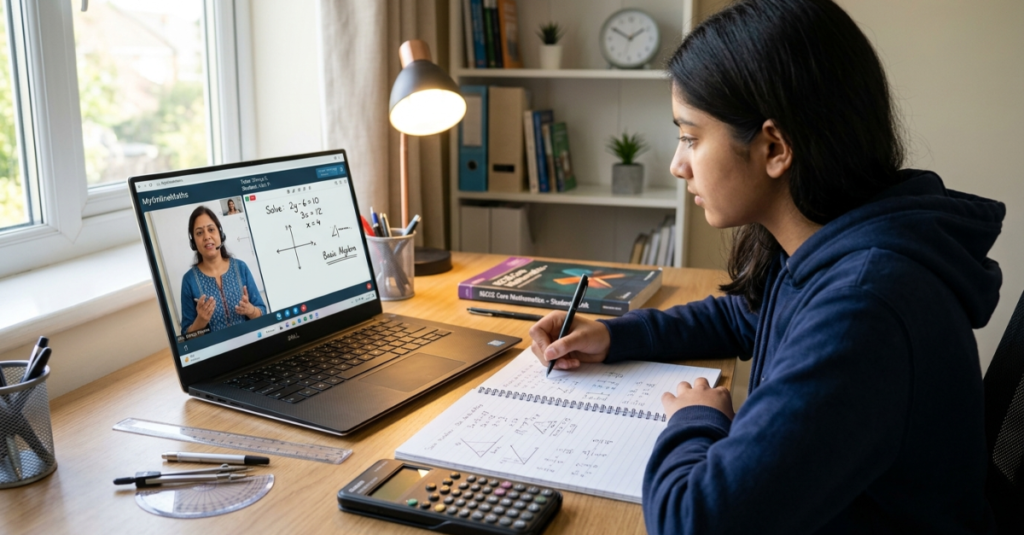
IGCSE Core Maths: The Power of Getting the Simple Things Right
There’s a common assumption students make early on. If something looks simple, it doesn’t need much attention. That idea works for a while, especially in maths. Topics like basic algebra, percentages, or fractions feel familiar, almost repetitive. So they get less time, less focus, and sometimes… less respect.
But when exam papers come back, the pattern becomes clear. Marks are not lost in the hardest questions. They’re lost in the ones that looked easy.
That’s where IGCSE Core Maths quietly changes the game. It’s not about solving the most complex problems. It’s about getting the simple things right, again and again, without slipping.
IGCSE Core Maths: Why Basics Decide Your Final Score
In IGCSE core maths, the challenge is not difficulty. It’s consistency. Students often know how to solve a problem. They’ve seen it before. They understand the method. But somewhere between reading the question and writing the final answer, small errors creep in. A missed sign. A rushed calculation. A step skipped because it “felt obvious.”
Individually, these don’t seem like big issues. But in an exam, they add up quickly.
| Common Situation | What Happens |
| Knowing method but rushing | Calculation mistakes |
| Skipping steps | Loss of method marks |
| Overconfidence in easy topics | Careless errors |
| Not revising basics | Repeated mistakes |
What makes a real difference is not learning more topics, but tightening control over the ones already learned.
Some students begin to notice that when they slow down slightly and focus on accuracy, their scores improve without needing to study anything new.
Key things that help here:
- Writing every step clearly instead of doing it mentally
- Double-checking simple calculations
- Practicing core topics more than once
- Treating easy questions with the same attention as harder ones
It sounds straightforward, but applying it consistently is where the effort lies.
Personalized IGCSE tutoring online: Fixing Gaps That Students Often Miss
Every student has certain areas they’re comfortable with, and others they quietly avoid.
The tricky part is that these weak spots are not always obvious. Sometimes a student doesn’t realise they’ve misunderstood something because they’ve been getting similar questions right by pattern, not by understanding.
This is where personalized IGCSE tutoring online starts to make a difference.
Instead of following a fixed plan, attention shifts to what the student actually needs.
For example:
- A student may be confident in percentages but struggle with multi-step problems
- Another might understand algebra but make frequent sign errors
- Someone else might lose marks only because of presentation and skipped steps
These are small gaps, but they affect performance more than expected.
With focused attention, these areas become clearer. Not overnight, but gradually.
- mistakes are identified early
- patterns in errors become visible
- corrections are made before they turn into habits
And once these gaps are addressed, students often notice something interesting. Questions that once felt uncertain begin to feel manageable.
IGCSE online private classes: Practicing Accuracy Over Guesswork
Practice is important, but not all practice leads to improvement. Many students solve multiple questions, check answers, and move on. It feels productive. But if the same type of mistake keeps appearing, practice alone isn’t solving the problem.
That’s where IGCSE online private classes change the approach slightly. Instead of focusing on how many questions are solved, the focus shifts to how they are solved. Are steps written clearly?
Is the method understood or just remembered? Are mistakes reviewed or ignored?
A small change in approach can make a noticeable difference.
| Practice Style | Outcome |
| Solving quickly without checking | Repeated errors |
| Skipping steps to save time | Loss of marks |
| Reviewing mistakes carefully | Gradual improvement |
| Practicing with guidance | Better accuracy |
Students who begin to slow down during practice often find that their overall speed improves later, simply because they make fewer mistakes. It’s not about doing more. It’s about doing it properly.
IGCSE Math Tutor Online: Turning Simple Concepts into Strengths
At some point, students realize that the topics they once ignored are actually the ones that need the most attention.
With IGCSE math tutor online, these concepts are revisited, not as something basic, but as something important.
Instead of rushing past them, they are broken down properly.
- why each step matters
- how different concepts connect
- where mistakes usually happen
This deeper understanding changes how students approach questions. They stop guessing. They stop skipping. They start thinking through the process.
Over time, this builds a kind of quiet confidence. Not the kind that comes from solving difficult questions once, but the kind that comes from getting things right consistently.
Some habits that begin to form:
- checking work without being told
- recognizing patterns in questions
- avoiding shortcuts that lead to mistakes
And once these habits are in place, even slightly harder questions feel less intimidating.
Conclusion
IGCSE Core Maths doesn’t demand complicated thinking as much as it demands careful thinking. The difference between average and strong performance often comes down to how well students handle the basics.
Not once, but every time. With support from personalized IGCSE tutoring online, IGCSE online private classes, and IGCSE math tutor online, students get the chance to identify where they’re going wrong and fix it in a structured way.
The improvement is not always dramatic, but it is steady.
And in maths, steady improvement often leads to strong results.
Eclassopedia helps students focus on these exact areas, making sure the simple things are done right, which is usually where the biggest difference comes from.
The Small Things Students Often Overlook (But Shouldn’t)
1. Why do I lose marks even when I understand the topic?
In many cases, it’s not about understanding but about execution. Small calculation errors or skipped steps can lead to lost marks.
2. Is practising more questions enough to improve?
Not always. If the same mistakes are repeated, practice needs to be paired with review and correction.
3. Why do simple questions feel tricky during exams?
Because they require precision. Even a small mistake can change the entire answer.
4. How do I reduce careless mistakes?
By slowing down slightly, writing steps clearly, and checking work before moving on.
5. Can focusing on basics really improve my overall score?
Yes, because a large portion of marks comes from these areas. Improving accuracy here has a direct impact on results.


