
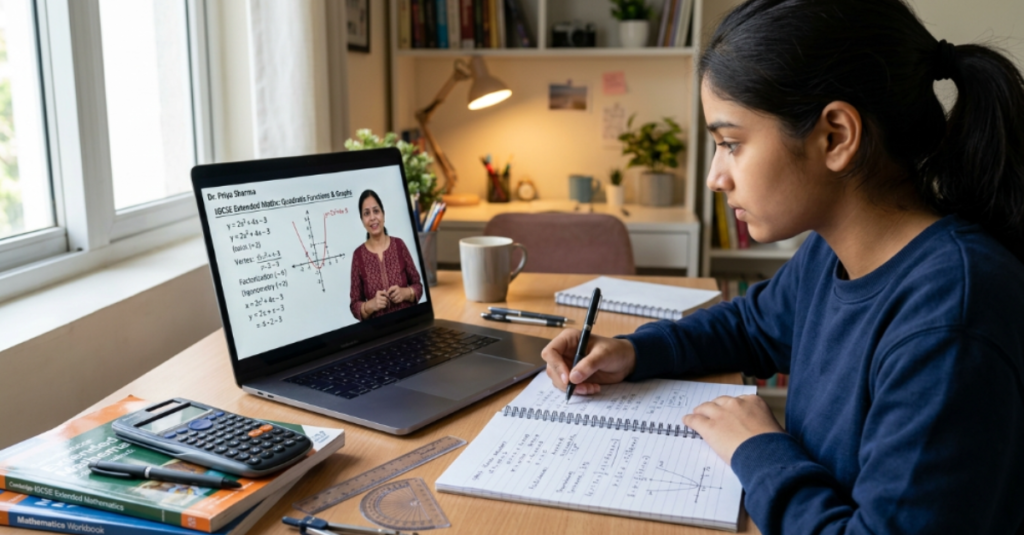
The Biggest Mindset Mistakes in IGCSE Extended Maths
If you’ve been working through IGCSE extended maths for a while, you’ve probably had at least a few moments where things just didn’t go the way you expected. You revise something, it feels okay, and then suddenly a question comes up that makes you stop and rethink everything you just studied.
It’s a strange feeling, because it’s not like you didn’t try. In fact, most students who struggle here are actually putting in a decent amount of effort. The problem is usually not effort—it’s the way that effort is being used.
IGCSE extended maths has this way of quietly demanding more than just practice. It expects you to think differently, and if that shift doesn’t happen, even simple things can start to feel harder than they should.
Mistake #1: Treating IGCSE extended maths as Just Harder Basics
A lot of people start off thinking IGCSE extended maths is basically IGCSE core maths with a higher level of difficulty. That assumption feels reasonable at first, and honestly, it works for a short while.
But then the questions start changing.
Instead of telling you what to do, they expect you to figure it out. That’s usually the point where things begin to feel confusing, even if you’ve practiced similar topics before.
Here’s a simple comparison that shows what’s going on:
| Aspect | IGCSE core maths | IGCSE extended maths |
| Question type | Predictable | Less predictable |
| Method use | Direct | Needs adjustment |
| Thinking | Follow steps | Choose steps |
What happens in real life is that students practice a set of questions, get comfortable, and then feel stuck when the pattern changes slightly. It’s not that they didn’t understand anything—it’s just that they understood it in a very specific way.
One thing that helps, even though it feels slower, is taking a bit of time to actually think about why a method works. Not in a very formal way, just enough to see what’s going on behind the steps. Over time, that makes a noticeable difference when questions look unfamiliar.
Mistake #2: Comparing Yourself to IGCSE Core Maths Students
This one doesn’t always get talked about, but it happens quite a lot. You see someone doing IGCSE core maths finishing faster or scoring well, and it’s hard not to compare your own progress.
The issue is that the comparison doesn’t really make sense, even though it feels natural.
IGCSE core maths and IGCSE extended maths are not just different in difficulty—they’re different in how they expect you to think. One is more about applying what you’ve learned directly, while the other asks you to stretch those ideas a bit further.
You can see it like this:
| Area | IGCSE core maths | IGCSE extended maths |
| Question style | Guided | Less guided |
| Thinking depth | Basic | More layered |
| Challenge | Steady | Varies more |
When you compare results across these two, it can make you feel like you’re behind, even when you’re not. That feeling builds up slowly and can affect how confident you are when solving questions.
A better way to look at it is to focus on your own progress. If something that felt confusing last week feels slightly clearer now, that counts. It might not feel like a big step, but it’s still progress.
Mistake #3: Ignoring the Bridge to IGCSE Additional Maths
Another thing that often gets missed is how much IGCSE extended maths connects to IGCSE additional maths. A lot of students treat it as something they just need to finish, without really thinking about what comes next.
But quite a few of the ideas you’re learning now show up again later, just in a slightly different form.
Here are a few examples:
| Skill | Where it shows up later |
| Algebraic manipulation | More complex equations |
| Graph understanding | Functions and curves |
| Logical reasoning | Multi-step problems |
If these areas are only half-understood, it doesn’t always cause problems immediately. But later on, those gaps tend to show up in ways that are harder to fix.
It helps to slow down just a little and make sure you’re actually comfortable with the basics, even if it feels like you’re spending more time than expected.
Mistake #4: Relying on the Wrong or Limited Resources
Sometimes the issue is not how much you’re studying, but how you’re studying. It’s possible to spend a lot of time working and still feel like you’re not improving much.
This usually happens when the resources you’re using are either too limited or not really connected to each other. For example, relying only on textbooks can make things feel clear but not exam-ready, while jumping between random videos can make learning feel scattered.
Here’s how different resources actually help:
| Resource Type | What it does |
| Textbooks | Explain concepts |
| Past papers | Show exam patterns |
| Guided help | Fix mistakes |
| best platforms for IGCSE tutoring | Provide structure |
When one of these is missing, something feels off. You might understand a topic but not be able to apply it, or you might practice a lot but keep making the same mistakes.
What works better is combining them in a simple way—learn, practice, check mistakes, and repeat. It’s not complicated, but it does require consistency.
Conclusion
In the end, improving in IGCSE extended maths is not really about doing everything perfectly. It’s more about making small adjustments in how you approach things.
Once you stop relying only on memorization, avoid unnecessary comparisons, pay attention to the basics, and use better resources, the subject starts to feel a bit more manageable. Not easy, but definitely less confusing.
And that shift alone can make a big difference over time.
Things You Might Be Thinking About
1. Why do I feel like I understand something but still get stuck later?
That usually means the understanding is there, but not flexible enough yet to handle different types of questions.
2. Is it normal for progress to feel slow sometimes?
Yes, especially when you’re moving from basic understanding to deeper thinking. That part always takes longer.
3. Can I improve even if I’m struggling right now?
Yes, because early difficulty is very common in IGCSE extended maths. It doesn’t mean you won’t improve.
4. How is IGCSE additional maths connected to this?
A lot of the same ideas continue, just in more detail, so a strong base now really helps later.
5. Do best platforms for IGCSE tutoring actually help?
They can, especially when they help you understand mistakes instead of just giving more practice questions.
Where to Go From Here
If your current approach feels like a lot of effort without much clarity, it might be worth adjusting how you’re studying rather than just doing more of the same.
Eclassopedia is designed to help with that, focusing on understanding and structure so that your effort actually leads somewhere.


